2026-10-27 14:54:15
SANWOOD HAST test chambers support accelerated moisture reliability testing for semiconductor and memory packages. This article explains HAST principles, compares HAST with THB and PCT, and introduces single- and dual-chamber configurations, engineering selection considerations and worldwide technical support.
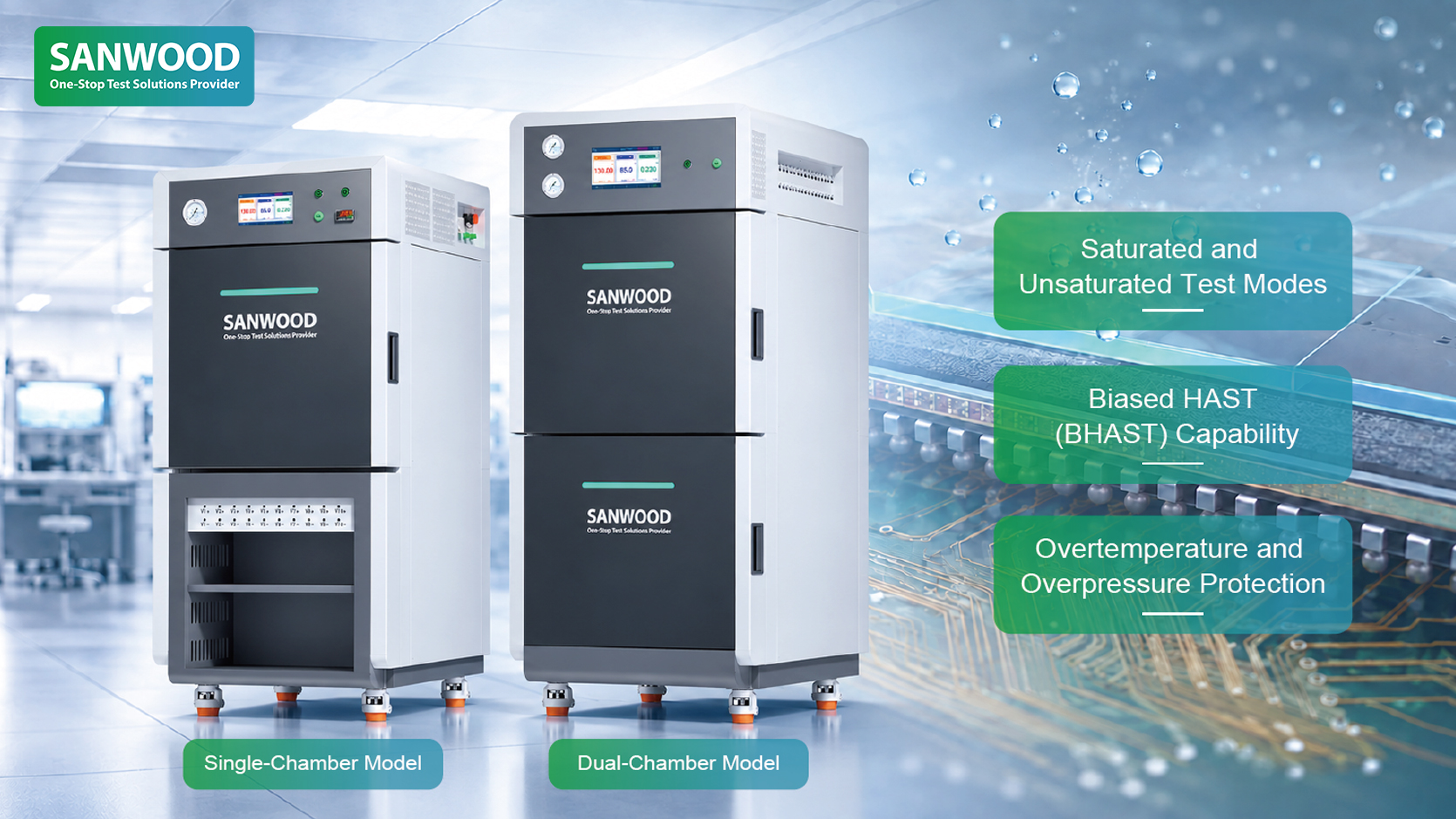
A HAST test chamber is a pressurized environmental test system used to evaluate moisture-related reliability in non-hermetic semiconductor packages. HAST stands for Highly Accelerated Stress Test. By combining elevated temperature and humidity under pressure, the test accelerates moisture exposure that can contribute to internal corrosion, insulation degradation and changes in electrical performance.
Engineers use HAST in IC package qualification, material evaluation and assembly-process verification. For packaged DRAM, NAND flash, logic ICs and other devices, the useful result connects a defined environmental exposure with electrical measurements and, where needed, package inspection.
SANWOOD manufactures HAST test chambers in single-chamber and vertically stacked dual-chamber configurations. Selecting the appropriate system involves the test method, electrical state, populated fixture and laboratory workload. This guide explains how those requirements fit together.
The pressure vessel enables a hot, humid environment above the normal atmospheric boiling point of water. The specified temperature and water-vapor conditions accelerate moisture transport through encapsulating materials and package interfaces, allowing engineers to investigate moisture-related degradation within the selected exposure period.
In common semiconductor HAST methods, the required environment is unsaturated and non-condensing. The intent is to expose the package to the prescribed moisture stress while avoiding unintended liquid water on the specimens. IEC 60749-24 describes this distinction for unbiased HAST.
Temperature, humidity and pressure must therefore be considered together. Increasing pressure alone does not define a valid HAST test. The method also establishes exposure timing, specimen preparation, electrical conditions and subsequent evaluation.
Transitions matter as well as the exposure plateau. Samples and fixtures can respond more slowly than the chamber environment during heating and cooling. Assess the proposed cycle with representative loading and follow the governing procedure for recovery and measurements.
HAST, temperature humidity bias testing and pressure cooker testing all address moisture reliability, but use different environments and electrical conditions. The following comparison separates the main method categories.
| Method | Test environment | Electrical state | Common reference |
|---|---|---|---|
| Biased HAST | Pressurized, elevated-temperature, unsaturated humidity | Specified electrical bias applied | JESD22-A110 |
| Unbiased HAST | Pressurized, elevated-temperature, non-condensing humidity | No electrical bias | JESD22-A118 |
| THB | Controlled temperature and humidity, commonly 85°C and 85% RH at atmospheric pressure | Electrical bias applied | JESD22-A101 |
| PCT or unbiased autoclave | Pressurized saturated steam or condensing moisture | No electrical bias in the referenced method | JESD22-A102; IEC 60749-33 |
These categories distinguish the exposure environment and electrical stress used in the respective moisture-reliability methods.
Biased HAST can provide a shorter moisture-stress exposure than conventional THB when the applicable qualification procedure permits it. A fixed conversion between HAST hours, THB hours and years of service life should not be assumed. The package, materials and relevant failure mechanism influence the relationship.
PCT is associated with saturated or condensing moisture exposure. Its results cannot automatically substitute for non-condensing HAST. A humidity control range that reaches 100% RH is an equipment characteristic; the selected test still needs to reproduce the method’s required environment.
Biased HAST combines moisture exposure with an electrical stress. It is relevant when the qualification plan needs to evaluate the effect of humidity while defined potentials are applied to the device. The bias pattern, voltage and current limits are part of the experiment.
Unbiased HAST evaluates package moisture resistance without applied electrical bias. IEC 60749-24 explains that omitting bias can reveal mechanisms that might otherwise be overshadowed, including galvanic corrosion.
Neither method is universally preferable. Select it from the governing qualification or investigation requirement. Applying bias also does not automatically mean running the device's full application workload; the prescribed electrical state must be defined separately.
For a biased configuration, specify the bias source, pressure-boundary feedthroughs, internal wiring, fixtures and required measurements. Confirm which items are supplied with the chamber and which are provided by the laboratory.
SANWOOD's published HAST applications include non-hermetic logic ICs, DRAM, NAND flash, microcontrollers, sensors and power management devices. Relevant package constructions include BGA, QFN and system-in-package assemblies.
The engineering question determines how the exposure should be used. Package qualification evaluates specimens against defined requirements. Material comparisons examine changes such as a candidate molding compound or underfill. Process verification investigates whether an assembly adjustment affects moisture reliability.
For an illustrative material comparison, keep the test vehicle and evaluation procedure consistent while documenting the reference and candidate materials. Retain the assembly lot, sample preparation and initial electrical results. This gives the team a basis for investigating any difference after exposure.
For memory products, identify the test article precisely. A packaged DRAM device, a memory module and a complete SSD present different constructions and interfaces. A component's use in an AI server or storage system does not by itself establish the appropriate HAST condition.
The published SANWOOD SM-HAST-45A environmental specifications provide a starting point for reviewing the intended test condition.
| Parameter | Published specification |
|---|---|
| Temperature control range | +105°C to +135°C |
| Special optional temperature version | +145°C |
| Humidity control range | 75% to 100% RH |
| Temperature fluctuation | ±0.5°C |
| Humidity fluctuation | ±2% RH |
| Temperature uniformity | 3°C |
These values refer to the published SM-HAST-45A.
For a project, confirm the required temperature, humidity and pressure as a combined operating condition, including whether pressure is expressed as gauge or absolute. Agree the applicable performance and loading conditions for the model being offered.
Temperature fluctuation describes variation over time at a measurement location. Temperature uniformity concerns the distribution across the test space. A review should identify both the measurement arrangement and the load, particularly when fixtures and wiring occupy a substantial part of the chamber.
SANWOOD's dual-chamber model has vertically stacked upper and lower chambers with independent control. It supports matching or different temperature, humidity and duration settings within each chamber's operating range.
A single-chamber model can serve a laboratory whose batches fit one exposure schedule. The dual-chamber arrangement is useful when development work and qualification programs need concurrent test windows. Separate chambers let each program retain its own recipe and batch history while using vertical laboratory space.
Consider a laboratory comparing a candidate package material while a second project is ready for qualification exposure. Independent chambers allow those activities to be scheduled separately. If results from the two spaces will be compared, establish consistent preparation and an agreed basis for comparing the chamber conditions.
Assess throughput using completed batches rather than chamber count alone. Fixture preparation, exposure, recovery and electrical measurements all consume time. Review the expected weekly workload to see where an additional test space will improve the flow of work.
Sample count becomes meaningful when it is connected to a loading drawing. Show the devices, boards or holders, connectors, wiring routes and required clearances. This allows usable batch capacity to be assessed from the complete arrangement.
For biased testing, include the electrical ratings and connection requirements. A physically suitable holder also needs to maintain the intended electrical arrangement throughout exposure. Review the fixture materials, insulation and connectors for the specified environment.
The proposal should identify the environmental and electrical supply boundaries, the records available from the supplied equipment and the external instruments required. That helps the laboratory prepare one working setup rather than assemble interfaces after delivery.
Before routine use, agree an application review or acceptance procedure with representative fixtures and loading. Define what will be measured, where it will be measured and which criteria establish acceptance.
Plan the evidence before starting the run. A useful record connects the specimen to the exposure and the subsequent electrical result.
Before exposure, identify the sample lot, package or material revision, preparation procedure and electrical baseline. Retain a fixture revision and sample-position map.
During exposure, associate the chamber and recipe with the batch. Keep the required environmental history, bias information and any interruptions. Establish how an interrupted run will be treated under the applicable procedure.
After exposure, record recovery and measurement timing, the electrical results and any follow-up inspection. When a failure occurs, preserve the evidence needed to investigate whether it follows a material, lot, electrical connection or loading position.
This sequence is a planning framework. Actual operating capability is established by the configured equipment and its verification records.
Use the method and revision required by the customer or qualification plan. Principal references include JEDEC JESD22-A110 for biased HAST and JESD22-A118 for unbiased HAST. IEC 60749-4 addresses semiconductor HAST, IEC 60749-24 addresses unbiased HAST, and IEC 60068-2-66 covers damp heat using unsaturated pressurized vapour.
AEC-Q100 provides a broader qualification framework for automotive ICs with relevant moisture-stress requirements. Device qualification depends on the required program and its results. The chamber, fixtures, electrical setup and procedure must together support the selected method.
Founded in 1995, SANWOOD Technology manufactures environmental test chambers, temperature forcing systems and memory burn-in systems. We operate an approximately 30,000 m² manufacturing facility in Dongguan, China, and serve customers in more than 100 countries and regions. Our management certifications include ISO 9001:2015 and ISO 14001:2015.
Our engineers support equipment selection and configuration around the specimen, test conditions and laboratory requirements. For a HAST project, this includes discussing the sample arrangement, electrical interfaces and preference for a single- or dual-chamber system.
SANWOOD provides installation, operator training, preventive maintenance, remote technical assistance, repairs and equipment upgrades. Depending on the location and project scope, support is delivered through SANWOOD engineers or local service partners.
Include commissioning, maintenance access and spare-parts planning in the equipment discussion. A defined support arrangement helps the laboratory prepare for installation and ongoing operation.
Conventional non-pressurized temperature humidity equipment does not reproduce the pressurized environment required for HAST. Select the apparatus for the prescribed exposure and method.
Semiconductor qualification reports include conditions such as 130°C and 85% RH. The governing method determines the actual condition, duration and electrical state. Confirm the complete operating condition for the proposed chamber and load.
Capacity depends on the populated fixture, specimen spacing, wiring and required clearances. A loading drawing provides a more useful basis than nominal chamber volume alone.
The exposure duration alone cannot establish field lifetime. A prediction requires a justified acceleration relationship, relevant failure mechanisms and defined use conditions.
Independent chambers can support separate exposure schedules within their respective operating ranges. Confirm the model configuration, electrical arrangements and records needed for each program.
Send SANWOOD the governing method, required temperature-humidity-pressure condition, exposure duration and planned batch quantity. Include sample and fixture drawings, bias requirements, preferred chamber format and installation country.
We can use these inputs to review a HAST test chamber configuration and the supporting installation, training and service scope for your laboratory.
Explore SANWOOD HAST Test Chambers
Email: info@sanwood.com
Sanwood is not just a company; it is a commitment to delivering high-quality products that stand the test of time.

 English
 中 文


 info@sanwood.com